Novel cellulose-based printed circuit board for resource-efficient electronics
Cellutronik develops a bio-based alternative to conventional printed circuit boards based on bacterial cellulose. The aim is to replace petrochemical materials with renewable resources. The new circuit boards are intended to be significantly more climate-friendly and suitable for industrial processing.Cellutronik develops a bio-based alternative to conventional printed circuit boards based on bacterial cellulose. The aim is to replace petrochemical materials with renewable resources. The new circuit boards are intended to be significantly more climate-friendly and suitable for industrial processing.
Printed circuit boards (PCBs) are everywhere: in our smartphones, cars and medical devices. Yet what is barely visible are the materials they are made of and the traces they leave behind at the end of their life cycle. In current printed circuit board manufacturing, the base materials consist exclusively of petrochemical resins combined with glass fibre fabric, which are difficult to recycle after use. The disposal of these materials generates a large amount of toxic electronic waste every year. One strategy to manage this waste stream is its use as a secondary fuel (e.g. in cement production), yet this approach does not provide a sustainable solution for closing the material cycle. To move beyond such downcycling approaches, the Cellutronik project aims to develop an environmentally friendly alternative to conventional PCBs. This is particularly challenging, as the technical requirements for PCB materials are extremely demanding, requiring high electrical, mechanical, and thermal performance. To address this challenge, Cellutronik takes an unconventional approach by using bacterial cellulose, a paper grown in the laboratory, as a base material. While this may sound surprising at first, it opens up entirely new scenarios for sustainable and environmentally friendly electronics of the future.
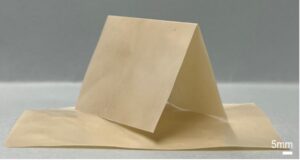
The bacterial cellulose, grown in the laboratory with the help of bacteria, combines properties one would hardly expect from a paper-based material: high purity, exceptional mechanical stability and a temperature resistance of up to 300°C. Moreover, its structure can be tailored to achieve controlled thickness and defined geometry, thereby meeting key requirements and positioning it as a promising candidate for modern PCB substrates. Furthermore, bacterial cellulose can be easily recycled at the end of its life cycle, enabling new pathways toward truly circular electronics. But how can this concept be translated into real-world PCB manufacturing?
Within the Cellutronik project, bacterial cellulose will be designed and optimized for PCB production, and its compatibility with established manufacturing processes will be demonstrated. To this end, two different manufacturing processes will be systematically investigated:
- Additive manufacturing, in which the conductive structures are deposited onto the cellulose substrate using digital printing.
- Subtractive manufacturing, where the cellulose substrate is subjected to lithographic processes.
By the end of the project, the developed bacterial cellulose-based substrate introduces a novel class of sustainable alternatives to conventional PCB materials and is expected to achieve at least a 25% reduction in carbon footprint compared to conventional FR4 printed circuit boards. In parallel, a key objective is to prepare a generated material and process data in accordance with FAIR principles and make them publicly available via the Material.DIGITAL platform.
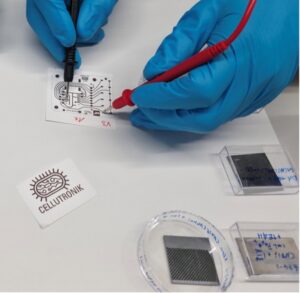
Focus areas and development goals of the consortium partners
The consortium brings together the research institutions Hahn-Schickard-Gesellschaft and the University of Stuttgart, along with the technology company Würth Elektronik.
Hahn-Schickard focuses on the inkjet printing of electrically conductive copper and silver inks for the direct deposition of conductive tracks and contact pads on BC substrates. Key research areas include thermal and photonic sintering of the inks to ensure reproducible electrical performance. Another innovative approach involves the fabrication of vias for multilayer systems using laser drilling and inkjet printing. Finally, soldering tests of SMD components on the printed structures will be performed to validate the reliability and practical applicability of the developed technologies.
The University of Stuttgart is responsible for the development of bio-based substrate materials made from bacterial cellulose. These materials can be engineered to achieve controlled thickness, defined geometry, and high mechanical stability. The use of sustainable culture media, such as okara and potato juice, ensures resource-efficient fermentation, which minimizes energy, chemical and water consumption. The aim is to compare the various nutrient media to identify the most suitable conditions for the cultivation of BC-based materials. In addition to uniform formation and mechanical handling, scalability and growth rate also play a pivotal role. Another focus is on structural design, where the integration of application-specific nanoparticles ensures improved flame retardancy and thermal stability of the BC-based substrates. A cold-pressing process increases fibre density, homogenizes the surface and reduces the moisture sensitivity of the BC substrates. Additional strategies will be explored to prevent or minimize the material’s water absorption.
Würth Elektronik leads the project and focuses on demonstrating the compatibility of BC-based substrates with established PCB manufacturing processes. This includes the fabrication of printed circuit boards using standard lithographic techniques in both single-layer and multilayer configurations. The electrical, thermal and mechanical properties of the resulting PCBs will be evaluated to confirm the performance of the novel materials while maintaining or improving existing quality standards. The fabricated PCBs will be assembled with components using established methods after manufacture. Another key aspect is the development and validation of a recycling concept to enable a closed material cycle and reduce environmental impact.