Sustainable glass ceramic cooktops thanks to polymer process technology
PowderLAS explores a new resource-efficient manufacturing process for lithium aluminosilicate glass-ceramics. The aim is to enable recycling while realizing new, complex component geometries. This will reduce material consumption, energy input, and dependence on lithium.
Lithium is an indispensable core component of modern battery systems, for example in electric mobility. For several years, battery manufacturers have been the world’s largest consumers of lithium. In addition to energy storage, lithium is now also required as an essential ingredient in other sectors of the economy. Not long ago, a completely different industry was the main consumer of this raw material – the glass‑ceramic industry. Although this industry is far less visible in the media than the electric‑mobility sector, the global demand for lithium raw materials (lithium carbonate, Li₂CO₃, and lithium hydroxide, LiOH) for household products such as glass‑ceramic cooktops and oven glazing is significant.
For every standard cooktop with dimensions of 60 × 60 × 0.4 cm³, more than 300 g of Li2CO3 are used. In Germany there are roughly 41 million households, and almost every one of them has a stove, many equipped with a glass‑ceramic cooktop. Assuming an average service life of 15 years, the annual demand for lithium raw materials amounts to almost 900 t in order to supply the already saturated German market with replacement material for worn‑out or defective cooking plates. Since today’s cooktops are often considerably larger, this number actually represents a lower bound. The demand for still‑unsaturated markets is correspondingly higher.
In 2021 alone, sales of cooktop panels manufactured in Germany reached approximately 200 million units. This required roughly 65 000 t of lithium raw materials. The material is produced by energy‑intensive melting of the raw materials at about 1600 – 1650 °C, during which CO2 is released by the decomposition reaction of Li₂CO₃ to Li₂O – a factor that, in times of rising CO₂‑emission pricing, is not only an environmental but increasingly also a cost issue. The fundamental manufacturing process has not changed for decades. After melting, the compositionally extremely balanced starter glass is shaped by casting or rolling and then subjected to a heat treatment (crystallization). Consequently, the resulting plates have a uniform thickness (≈ 4 mm).
Currently, glass‑ceramic cooktops are not recycled, because to be remelted for glass production they would have to be sorted by material type. Even though there are only a handful of glass‑ceramic manufacturers worldwide, the risk of contamination is too high for the required glass quality. Because of the persistently high global demand, increasing efforts are being made to recycle lithium‑containing glass‑ceramics. However, large‑scale recycling is still hampered by a lack of legal framework and, due to limited media attention, a shortage of coherent concepts on how to achieve full‑value recycling of these materials.
It must therefore be concluded that current manufacturing methods for glass‑ceramics require large amounts of lithium for the production of cooktops. These lithium quantities are neither recycled in the process nor can the material be formed into geometries other than simple flat plates; consequently, today’s cooktops are essentially flat. A method that (1) recycles this material and (2) enables the production of more complex shapes than flat sheets would not only solve a serious resource‑and‑waste problem but also open new possibilities for product design.
This is where powderLAS comes in: it proposes an entirely new manufacturing process for glass‑ceramics that allows recycling, reduces raw‑material consumption, and provides greater design freedom. The work focuses on lithium‑aluminosilicates (LAS), which form the basis of glass‑ceramic cooktops. LAS glass‑ceramics are highly thermomechanically stable and can withstand temperature shocks of up to 1000 °C. The dominant crystalline phase in LAS glass‑ceramics (a high‑quartz solid solution) exhibits a negative coefficient of thermal expansion (CTE). This negative CTE contrasts with the positive CTE of the remaining glass phase. By deliberately adjusting the phase ratios, the overall thermal expansion coefficient of an LAS glass‑ceramic can be tuned over a wide range. Very low or near‑zero CTEs are often achieved, making this material system extremely attractive for applications involving high thermal cycling.
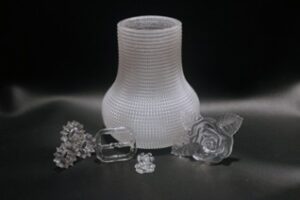
The intended process should enable the economic production of this highly relevant glass‑ceramic material system with modern plastic‑processing technologies, thereby granting virtually unrestricted design freedom for glass‑ceramic components. The method is based on a powder‑based approach that was recently developed for structuring glass and has been brought to market in Germany under the name Glassomer® technology.