Development of highly thermally conductive silicon nitride ceramics from recycled silicon for use in power electronics and semiconductor manufacturing processes
SiR2SiN develops highly thermally conductive silicon nitride ceramics made from recycled silicon. These materials are particularly relevant for power electronics and semiconductor manufacturing. The use of secondary raw materials significantly lowers energy consumption and CO₂ emissions.
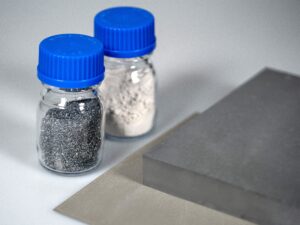
Highly thermally conductive silicon nitride (Si₃N₄) materials and components are key technologies in the growing areas of power electronics and semiconductor manufacturing. In power electronics, Si₃N₄ materials with high thermal conductivity are of particular interest, as they are used in temperature‑cycle‑resistant Cu‑Si₃N₄ AMB substrates. In combination with SiC semiconductors, they form the core of power electronic components for controlling and regulating high currents and voltages – for example, in battery electric vehicles, battery energy storage systems (BESS), wind turbines, and increasingly also in photovoltaic applications.
In semiconductor manufacturing, Si₃N₄ ceramics serve as holding structures for wafer processing (wafer chucks), where exceptionally high requirements exist regarding thermal conductivity, electrical resistance, and purity.
The starting material for Si₃N₄ ceramics, silicon nitride powder, is predominantly produced via a nitridation process using silicon powder. Silicon itself, however, is classified as a critical and strategic raw material. Moreover, the production of metallurgical‑grade silicon (MG‑Si) and polysilicon requires an extremely energy‑intensive process associated with significant CO₂ emissions (10.8 kg CO₂‑eq./kg MG‑Si).
A sustainable alternative to MG‑Si is the use of secondary silicon as a future raw material. This includes silicon waste generated during sawing, grinding, and polishing of high‑purity crystals, as well as, in the future, large volumes of silicon recovered from end‑of‑life photovoltaic modules. This high‑quality recycled silicon is currently used primarily in downcycling processes but has enormous potential for producing high‑thermal‑conductivity Si₃N₄ ceramics and can significantly contribute to increased resource efficiency and CO₂ reduction in the manufacturing process.
To make secondary silicon suitable as a raw material for Si₃N₄ ceramic production, both a sufficient purity level and an appropriate particle size distribution for the nitridation process must be ensured. Therefore, specially tailored separation and purification routines need to be developed. The subsequent material development, targeting a thermal conductivity of more than 110 W/(m·K), is pursued through two approaches. First, specially engineered α/β‑Si₃N₄ powders are to be produced from the processed recycled silicon via direct nitridation. These powders will then be used for producing bulk ceramics through powder processing, forming, and sintering. Second, the direct nitridation of recycled silicon into sintered reaction‑bonded silicon nitride (SRBSN) will be investigated. In this technology, nitridation occurs directly on the shaped component, eliminating the need for an intermediate Si₃N₄ powder step.
The scientific and technical challenge for both approaches lies in the reproducible control of the nitridation process to precisely achieve the desired powder and material properties. Since both processing routes offer different advantages in terms of energy efficiency, scalability, material performance, and environmental compatibility, they will be investigated in parallel and systematically evaluated within the project. This enables the identification of the technologically and economically optimal route for developing customized, high‑thermal‑conductivity Si₃N₄ materials based on secondary silicon.
The goal of the research project SiR2SiN is therefore to develop a high‑purity, high‑thermal‑conductivity Si₃N₄ ceramic (> 110 W/(m·K)) from recycled silicon while achieving at least 60 % CO₂ reduction.