
There is no simple answer to this question due to the nearly infinite diversity of different materials and multiple ways in which we get into contact with them. A simple example may demonstrate the concept of risk: Are felines generally dangerous? It depends on whether the animal is a domestic cat or a predatory cat! And even if the animal is indeed a lion, do you willingly put your head into its mouth or are you just visiting a zoo where a fence protects you from the wild animals?
This comparison clearly illustrates the two important components necessary for describing the term risk namely “hazard” (only the lion could kill you) and “exposure” (no contact with the lion if you’re staying behind a protective fence means no or zero exposure). Only if both requirements – hazard and exposure – are true, then we talk about a risk. In the same way, to understand the risks of nanomaterials, we need to have a closer look on the individual materials and the potential for exposure to estimate the potential risks for health and the environment.
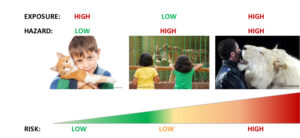
Risk in Toxicology
A possible risk of a certain material is defined as a function of its hazard and the likelihood of exposure. If either of the two factors is zero (‘no hazard’ or ‘no exposure’), the resulting risk is also zero. The same also applies to innovative materials. Taking a nanomaterial as example, it bears a certain hazard, which depends on the specific properties of each material, like the different danger levels arising from pet cats and lions. Additionally, the likelihood of exposure to a nanomaterial depends on the specific setting: is the nanomaterial incorporated into a solid matrix such as fullerenes or carbon fibres in a tennis racket? In that case the likelihood of human exposure is low. On the other hand, if the nanomaterial is in a spray product (as an aerosol) the likelihood of human exposure is high. However, the exposure and thus the risk can be minimised if this spray is used in a closed industrial process with proper safety measures. Transferring this to the animal example above: if the lion stays in its cage, the exposure to the animal is zero thus no risk arises. However, if the cage is open, an exposure is possible which in turn means that the lion poses a risk for us. It is therefore important to consider the individual exposure settings for a product containing innovative materials since adequate safety measures can be applied to minimise exposure and thus the potential risk itself.
Looking at the toxicology of innovative materials in general, hazard varies from low to high, depending on the respective (nano)material. Soluble materials, like those made of e.g. silver, zinc or copper oxide, can release ions independent of their particle size and those ions are known to have toxic effects. Specific nanomaterials catalyse or enhance the formation of reactive oxygen species (ROS), which induce inflammatory effects in cells and tissues in high concentrations. Furthermore, fibre-like nanoobjects such as carbon nanotubes or carbon fibres can also harm cells if they fulfil specific toxicity criteria (so-called WHO fibres).
Exposure to certain materials including nanomaterials is a crucial factor when determining the risk(s). For some applications and consumer products, the innovative material is firmly embedded or entrapped in a solid or liquid matrix material, meaning there is little exposure and thus low risk. This may change however, once the product or the material containing a nanomaterial reaches the end of its lifecycle and ends up in waste incinerator plants, landfills or during recycling. In addition, abrasion can occur during use leading to a release of nanoparticles.