The Safe-and-Sustainable-by-Design (SSbD) approach aims to develop safe and sustainable chemicals, materials and products. A new study examines how the SSbD principles complement those of the circular economy, such as material conservation, substitution, extending product lifespans and recycling.
The circular economy and SSbD are interlinked concepts that contribute to a vision that meets the needs of all people without exceeding planetary boundaries. This requires a reduction in raw material consumption, which can only be achieved if recycling is accompanied by other strategies, such as avoiding certain products or extending the lifespan of products. Not all circular economy strategies are suitable for all products and all value chains, or even feasible. For example, reuse is not possible for consumer goods such as personal care products. Reduced consumption of raw materials benefits the environment, is better for the climate and makes countries less dependent on imports. The study’s key finding is therefore that we must drive forward innovations aimed at reducing resource consumption and utilising renewable and secondary materials and products.
To this end, two key innovation strategies are proposed, both of which link the two concepts:
(1) The SSbD framework can facilitate a redesign based on the circular economy (by slowing down or closing the loop). This ensures that products currently in the economic cycle (existing stock) are recirculated safely and sustainably (e.g. if they contain hazardous chemicals).
(2) The development of new products (and product chains) that take into account findings on safety, sustainability and circular economy strategies, with the SSbD principles at the centre
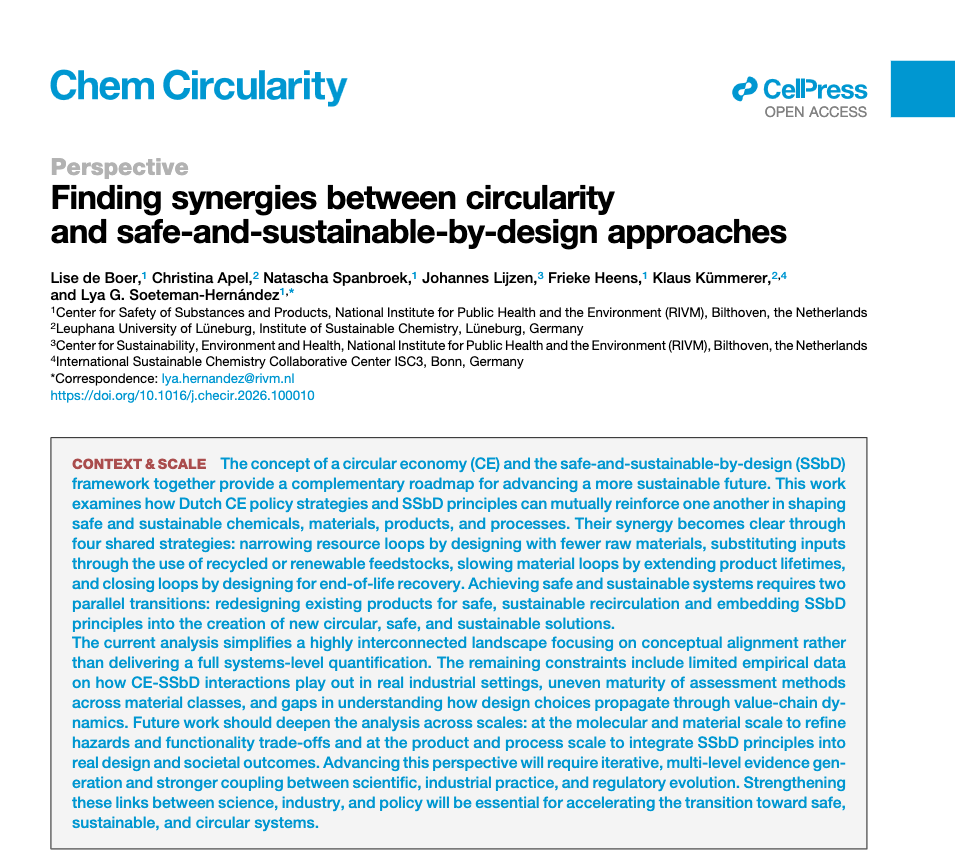
Publication:
- Lise de Boer, Christina Apel, Natascha Spanbroek, Johannes Lijzen, Frieke Heens, Klaus Kümmerer, Lya G. Soeteman-Hernández (2026) Finding synergies between circularity and safe-and-sustainable-by-design approaches. Chem Circularity, Volume 1, Issue 2, 100010, https://doi.org/10.1016/j.checir.2026.100010.