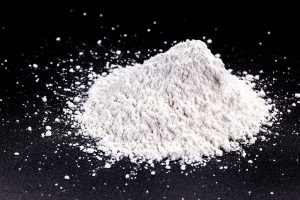
Nanoclays are based on naturally occurring clays, which mainly consist of very fine mineral particles. The mineral particles of the clays mostly consist of layers of silicates, which are compounds based on the elements silicon, oxygen and other elements.
The basic building blocks of layered silicates are SiO4 tetrahedra. These building blocks can be connected to each other via common oxygen atoms. They can be thought of as "stacks" of 2-dimensional single, double or multiple layers. The layers are not linked to each other and can absorb or release water and other substances between the layers and can thus swell or shrink, which rigid framework silicates (see also zeolites) cannot do.
Layered silicates include groups of minerals such as mica, talc, kaolin, serpentine, montmorillonite or sepiolite. They differ, in one way, in the size and sequence of the areas in which the SiO4 tetrahedra are oriented upwards or downwards in the planes. Further, layered silicates can be differentiated by the presence of other elements, such as aluminium, that can take the position of the silicon components,.
Nanoclays are inflammable. They are used in flame and fire protection for plastics. They are added to the plastic, reducing the amount of flammable material. If the plastic catches fire, a separating layer is formed that inhibits it from burning further. The special properties of nanoclays, such as their chemical resistance, mechanical strength and thermal stability, have made them essential for today’s electrical and electronics industry. Powder consisting of nanoscale nanoclays is also not self-igniting. Even as a finely dispersed mixture with air (dust) under the influence of an ignition source, nanoclays are not flammable, so there is no risk of a dust explosion.
Bentonites consist of nanoclays. Bentonitesare not a uniform substance but a mixture of different clay minerals. One main component is montmorillonite. Bentonites or montmorillonite are not a new material per se, but they are used in some innovative applications. A typical montmorillonite particle consists of layers about 1 nm thick which form large stacks. These large stacks contribute to the bentonite’s large total surface area, which makes the material a valuable absorbent. Absorption is a simple and effective strategy for the removal of pollutants or for water/wastewater treatment. An increasing number of publications on the absorption of toxic compounds by modified bentonites shows that there has recently been a growing interest in new low-cost absorbents for water treatment. Nanoclays can also bind radioactive caesium dissolved in water. Thus nanoclays can be used to reduce radioactive contamination like that from Fukushima .
In the animal feed industry, some bentonites have been approved by the German Ministry of Agriculture (BVL) to be used as an additive to bind fungal toxins, for example, and thus prevent them from causing harm.
Another use example is cat litter, which is typically composed of a mixture consisting of zeolites, sepiolites or bentonites or montmorillonites. This mixture is remarkable for its high absorption capacity for water and odour-causing components of cat urine and faeces.
When bentonite is mixed with water, the large stacks of montmorillonite adhere to each other and give the bentonite a strong binding capacity, making it suitable as a binder and as an additive to improve flow properties. Therefore, bentonite is often used as an ingredient in medicines and cosmetics and in industrial processes (e.g. for drilling fluids) to improve the rheology .
Other areas of application are, for example, as a plastic additive in food packaging films and plastic bottles. Furthermore, nanoclay-added plastics often have higher tensile strength, improved barrier and abrasion properties, excellent surface qualities, low thermal expansion and very good flow and processing properties. This outstanding performance profile makes plastic nanoclay composites an interesting alternative to conventionally reinforced materials. In addition, with the help of nanoclays, chemically incompatible plastics can be mixed to create a plastic that optimally combines the properties of both plastics. Recently, this has also been discussed for 3D printing applications, which means that plastic nanoclay composites could be regarded as an innovative material .
Natural occurrence and production
Nanoclays are mainly produced on the basis of the naturally occurring sedimentary rock bentonite, which in turn consists of 60 to 80 percent montmorillonite. Montmorillonite is named after a rock deposit near Montmorillon in southern France, bentonite after a clay deposit in Wyoming, USA near Fort Benton. Montmorillonite is an extra-fine clay mineral that is formed by the weathering of volcanic ash, tuffs and basic rocks (e.g. basalts). In Europe, important deposits are found, for example, on the Greek island of Milos and in Turkey and Germany. The largest German deposits are found in Bavaria.
Natural bentonites are preferred for many applications and products in the cosmetics and agricultural industries and also as cat litter.
In order to further increase the current growing capacity of natural bentonites in water for applications in the foundry industry, the construction and drilling industry and in the food sector, alkaline activation is often used. In this process, the cations (magnesium, aluminium, calcium) in the intermediate layers of the montmorillonite are replaced by sodium ions. In technical production, a kneading activation with soda (Na2CO3) is followed by a drying process, which is followed by a grinding step of the sodium montmorillonite.
Acid-activated bentonites are used in paper production and as catalysts. These activated Bentonites are used when large surfaces are required. Through reaction with acids, cations (magnesium, aluminium, iron) are extracted from the intermediate layers and replaced by hydrogen cations (protons). Depending on the degree of acid activation, large specific surfaces of up to 450 m²/g can be achieved .
Lipophilic bentonites are used to adjust the flow properties of oils, fats, ointments and plastics. These are preferably produced from alkali-activated bentonites and for this purpose are treated with organic nitrogen compounds (ammonium compounds), such as those found in commercially available fabric softeners. The organic modification makes the originally hydrophilic surface of the bentonite hydrophobic, thus allowing the complete dispersion of the individual layered silicate platelets in organic (hydrophobic) solvents. This is important if you want to use water-repellent nanoclays to specifically influence the flow properties of solvent-based paints and varnishes or to produce plastics.
Further Information
Update 2022