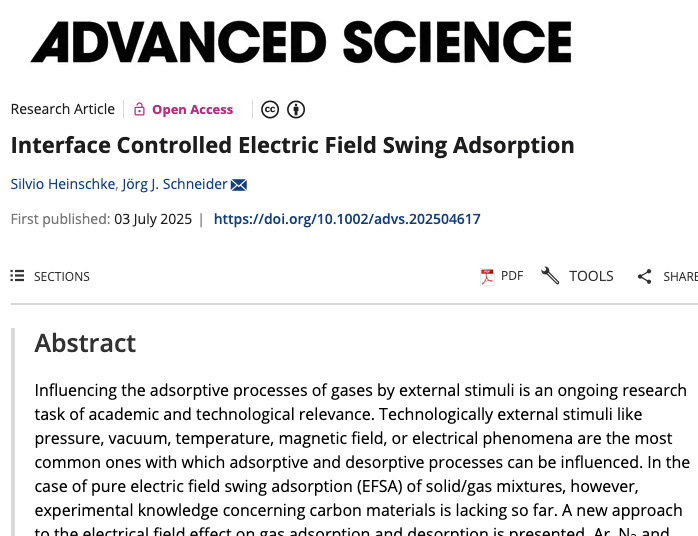
A research team at TU Darmstadt has developed a new type of composite material made from carbon and silicon dioxide. This material selectively binds gases such as CO₂, N₂, and argon from the air and can completely release them simply by applying or removing a low electrical voltage.
The interfaces created in the millimeter range between the conductive and insulating materials generate strong field gradients. These gradients polarize the gaseous molecules, allowing them to adhere to the surface in a completely reversible manner. This technology enables low-energy swing adsorption and desorption, paving the way for efficient separation processes in gas purification.
The results of this research were published in the journal Advanced Science under the title “Interface Controlled Electric Field Swing Adsorption.”
Original publication:
Silvio Heinschke, Jörg J. Schneider; Interface Controlled Electric Field Swing Adsorption. Advanced Science (2025); DOI: 10.1002/advs.202504617