Production
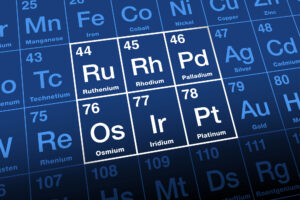
Rhodium is a rare precious metal belonging to the platinum group metals. It is primarily obtained together with platinum as a by-product of nickel, iron, and copper mining. As a result, specific sustainability indicators for rhodium are difficult or even impossible to determine.
The Republic of South Africa, the Russian Federation, Canada, and Zimbabwe were the world’s most important rhodium-producing countries in 2022. In 2019, global rhodium production amounted to 25 tons, of which 20 tons came from South Africa alone. Mining is carried out predominantly underground, although some operations also use open-pit methods.
Similar to ruthenium, rhodium is also a by-product of nuclear fission and can theoretically be recovered from spent nuclear fuel. However, due to the radioactivity of the other materials in the fuel elements and the associated safety requirements, rhodium is not extracted in this way.
Ressource consumption during processing
Land use for rhodium extraction is comparable to that of copper mining. Underground mining requires less surface area, as less waste rock needs to be stored.
Water consumption per ton of ore extracted is high during mining operations. In addition, energy and water consumption for further processing of the ores are substantial.
Safety
Similar to ruthenium, rhodium is non-toxic in its metallic form. In powder form, it is slightly flammable. Rhodium compounds, however, can be corrosive to the eyes, skin, and lungs, and various regulations exist for the safe handling and use of rhodium. Rhodium may be toxic to aquatic organisms. However, its toxicity is lower than that of platinum and palladium. Since it occurs only in very small quantities in the environment, no significant effects on environmental organisms are expected.
There is some evidence suggesting a potential carcinogenic effect of rhodium and its compounds.
Emissions
Rhodium is obtained as a by-product of mining other materials. Ore deposits in Russia and Canada contain very high sulfide levels. Direct sulfur dioxide emissions are therefore considered critical, and gas-cleaning systems are used during smelting to treat exhaust gases accordingly. In tailings ponds, high sulfur content can lead to acidification, which is why measures have been established to reduce sulfur levels in the waste material.
Indirect emissions generated during further ore processing must also be considered critical — primarily carbon dioxide, but also nitrogen oxides. The electrical energy used for smelting rhodium-bearing ores in South Africa (and also in Zimbabwe) is largely generated from coal-fired power plants and is therefore associated with high CO₂ emissions. Washing the ore can produce heavy metal-containing sludges that, in some mining regions, contaminate rivers and groundwater.
In contrast, rhodium is particularly important in vehicle exhaust catalysts, where it plays a key role in converting nitrogen oxides into nitrogen.
Social Aspects
The level of corporate concentration in rhodium mining is considered high. This means that only a small number of stakeholders benefit from the profits generated by its extraction.
According to the weighted country risk for rhodium-producing countries — which incorporates the World Bank’s Worldwide Governance Indicators — around 80% of production originates from countries with medium to weak governance. This indicates that in many producing countries there is a need for improvement in areas such as political stability, voice and accountability, security, and anti-corruption efforts.
For responsible metal production, supply chain due diligence within the EU is becoming increasingly important (see also the German Supply Chain Due Diligence Act). The law requires the documentation or certification of social standards and occupational health and safety measures, although initially only for companies with more than 1,000 employees.
Waste and recycling
Due to the extremely rare occurrence of rhodium, its high cost, and its versatile use as a catalyst and as a component in electrical devices, recycling is economically attractive and, for example, well established in the case of automotive catalysts. Special recovery powders are available for reclaiming rhodium from precious metal plating baths.
In addition, rhodium is present in spent nuclear fuel elements; however, it is not currently recovered from them, as the process would be highly complex due to the radioactivity of the other elements involved.
How can the material be made more sustainable?
The use of renewable energy in extraction and smelting processes could significantly reduce greenhouse gas emissions.
Almost 90% of the rhodium available in 2019 (35.5 tonnes) was used in automotive exhaust catalysts. Due to increasingly stringent emission control requirements, demand is generally expected to rise; however, the growth of electric mobility will likely reduce demand for catalytic converters.
More efficient use in catalysts, improved recovery from waste streams, and research into potential substitute materials can help reduce rhodium consumption. More sustainable use also requires high recycling rates and a circular system with minimal material losses.
Further information:
Created in 2026 (Project MANTRA)